 The First
Phase
The First
Phase
The first
phase in the development of
Cycladic figures is called
the “Clay Grottas”
civilization, extending
from 3200 B.C. to 2800 B.C.
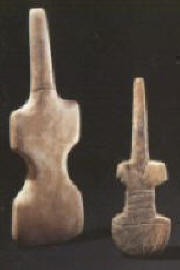
In this period, the
characteristic features of
the idols are their flat,
one dimensional surfaces,
the suggestively
anthropomorphic features
embodied within the “violin”
shape, so-called primarily
because of the absence of
the human head.
In the same period occur
idols of the Plastira type,
discovered in the
excavations of an ancient
cemetery in the village of
Plastiras in the north part
of the island of Paros.
Characteristic of this style
of figures are human forms,
distinguishing sexual
features with head, feet,
and arms crossed on the
chest.
This
period ends with figures of
the Lourou type, discovered
in excavations of the
ancient cemetery in the
village of Louros on the
island of Naxos. These idols
are straight-standing, flat
surface images, once again,
suggestive of the human
figure, but without faces or
arms. Archaeologists agree
that these figures represent
the end of the first phase
of Cycladic figure
development.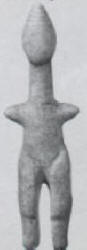
In the same period occur
idols of the Plastira type,
discovered in the
excavations of an ancient
cemetery in the village of
Plastiras in the north part
of the island of Paros.
Characteristic of this style
of figures are human forms,
distinguishing sexual
features with head, feet,
and arms crossed on the
chest.
This period ends with
figures of the Lourou type,
discovered in excavations of
the ancient cemetery in the
village of Louros on the
island of Naxos. These idols
are straight-standing, flat
surface images, once again,
suggestive of the human
figure, but without faces or
arms. Archaeologists agree
that these figures represent
the end of the first phase
of Cycladic figure
development.
The
Second Phase
The next phase of Cycladic
Civilization is called the
Kerou Sirou civilization
period, which extends
between 2800 B.C. to 2200
B.C. Characteristic of this
type of figure are the
upward tilt of the head,
bent legs, and elevated
heels. There are many
different types, depending
upon where they were found,
among which are Kapsalon,
Spendou, Duodekathismaton,
Chalandrianis, and Koumasi.
In this phase, Cycladic
artists also produced
statues which reached up to
1,5 meters (60”) in height.
Parallel to this are three
dimensional figures
depicting human male forms
playing musical instruments.
The Third
Phase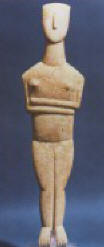
The
development of Cycladic
idols ends in this third
phase, called Phylaci
Civilization, and dating
from 2200 B.C. to 2000 B.C.
This period marks the
gradual decline in
production of Cycladic
figures. After 2000 B.C.,
there are no more Cycladic
forms. These images are
similar to those of the
Second Phase.
Interpretations of the Idols
|